

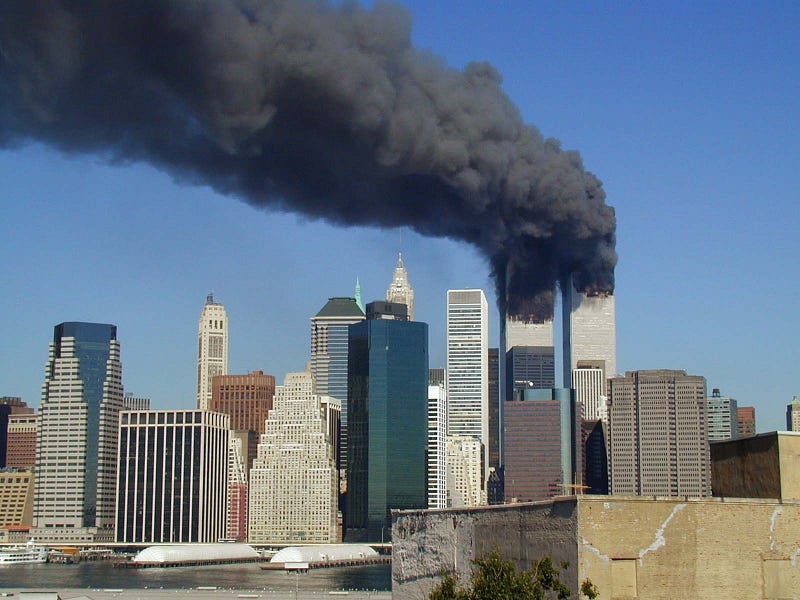
September 11, 2001, began for me like any other workday.
Although my shift started at nine in the morning, that day I arrived a few minutes early at the newsroom of a television station in Santo Domingo, where I had been working for just over a year.
Nothing suggested that this particular Tuesday would become one of those days that, for some reason, remain permanently etched in memory.
I remember some of my colleagues watching CNN, especially one of the editors recording the broadcast for the afternoon newscast.
When she saw me arrive, she told me that a small plane had crashed into one of the towers of the World Trade Center in New York and that, at that point, everything seemed to indicate it had been an accident.
Up until then, that was what we understood had happened.
I stood there watching the images of the burning tower.
Then something happened that, for several seconds, I could not make sense of: a plane appeared on the screen and slammed into the other tower, although in the confusion of the moment I did not realize that I was witnessing a second impact.
Still stunned, my first reaction was to think that CNN was replaying footage of the small plane crash the editor had told me about.
But something did not add up.
Because of the camera angle, the speed at which everything happened and probably the sheer confusion of the moment, the aircraft even looked like a fighter jet to me. It all happened too quickly for me to make it out clearly.
A short while later, when the broadcast began referring to a second plane, I realized that what I had just seen was not a replay.
It was another plane.
And as the minutes passed, that initial version — that a small aircraft had struck the first tower — also began to fall away.
The reality was far more serious: both towers had been struck by large commercial airliners.
That was the moment I understood that what had happened could not have been an accident.
I remember telling the people around me that two planes crashing into the Twin Towers like that could not possibly be a coincidence. It had to be deliberate.
Shortly afterward, I made a phone call and said a phrase that I still remember with absolute clarity: They’ve touched the giant’s finger.
For years, I did not know exactly why I had used those words. Today, I think I was probably recalling Pearl Harbor, the movie that had been released only a few months earlier, and that idea of having awakened a giant.
Whatever association my mind made in that instant, the phrase came out spontaneously because I immediately had the sense that what we had just witnessed would have enormous consequences.
But there was still so much we did not yet understand about the magnitude of what was unfolding.
Over the next several minutes, I watched both towers burn.
And I never thought they would fall.
Never.
I believed they would manage to bring the fires under control. The buildings had suffered enormous damage, yes, but I thought they would hold. I looked at those immense structures and simply assumed that, somehow, they would remain standing.
That was the hope I held on to as the story continued to unfold.
Until one of them began to collapse.
The South Tower, the second to be struck, was the first to fall.
I remember sitting there, transfixed by the screen.
Speechless.
And the most horrifying part was realizing that what we were watching was happening in real life. There were people inside those towers. There were people in the streets. There were people trying to escape as a building more than a hundred stories tall disappeared before our eyes.
Even then, I held on to the hope that the other tower would remain standing.
It did not.
Not long afterward, the North Tower collapsed as well.
And I think that was the moment when the feeling finally settled in that we were witnessing something whose true magnitude we still could not fully comprehend.
From that point on, for me, everything came to a standstill.
Or at least that is how I remember it.
What had begun as an ordinary workday was completely transformed. The work, the conversations, the priorities of that day — everything came to revolve around the same thing.
For those of us working in the media, the event placed an enormous burden on us. We had to follow every new piece of information as it came in while trying to process it ourselves. We had to keep working as the magnitude of what had happened continued to grow and seemed to become more terrible with every new report.
Perhaps that is why I remember some moments with such clarity and almost nothing about others.
I do not remember exactly what I said when I left work. I do not remember what conversations I had at the end of that shift. There are hours from that day that my memory seems to have erased.
But I remember that screen.
I remember that editor recording the CNN broadcast.
I remember thinking the second impact was a replay.
I remember that plane entering the frame.
I remember that phone call.
I remember thinking the towers would hold.
And I remember watching them fall.
Twenty years later, in November 2021, I traveled to New York City for the first time.
On one of my first walks through the city, I went alone to the place where the Twin Towers once stood.
I spent a long time at the 9/11 Memorial, looking at the names engraved around the enormous reflecting pools that now occupy the footprints of the towers.
Two decades had passed.
New York was right there in front of me, no longer on a television screen in a newsroom in Santo Domingo.
As I moved past those names, for a moment my mind returned to that overwhelming morning.
To the images.
To the disbelief.
To the 25-year-old man who had gone to work thinking it was just another Tuesday and who, minutes later, was watching the world change before his eyes.
Twenty-five years have passed.
There is nothing extraordinary about my story from that day. I was thousands of miles away from Ground Zero. I did not lose anyone. I did not have to run. I was not among those who experienced the horror firsthand.
I was simply one of the millions of people who watched the attacks unfold in real time.
But there are days that cease to belong only to those who were there. They also take root in the memories of those who watched from afar and who still remember where they were, what they were doing and who was beside them when it happened.
September 11, 2001, was one of those days for me.
The day I went to work like any other morning and watched, quite literally, everything come to a standstill.
This piece was originally published in Spanish. You can read the original version here.