

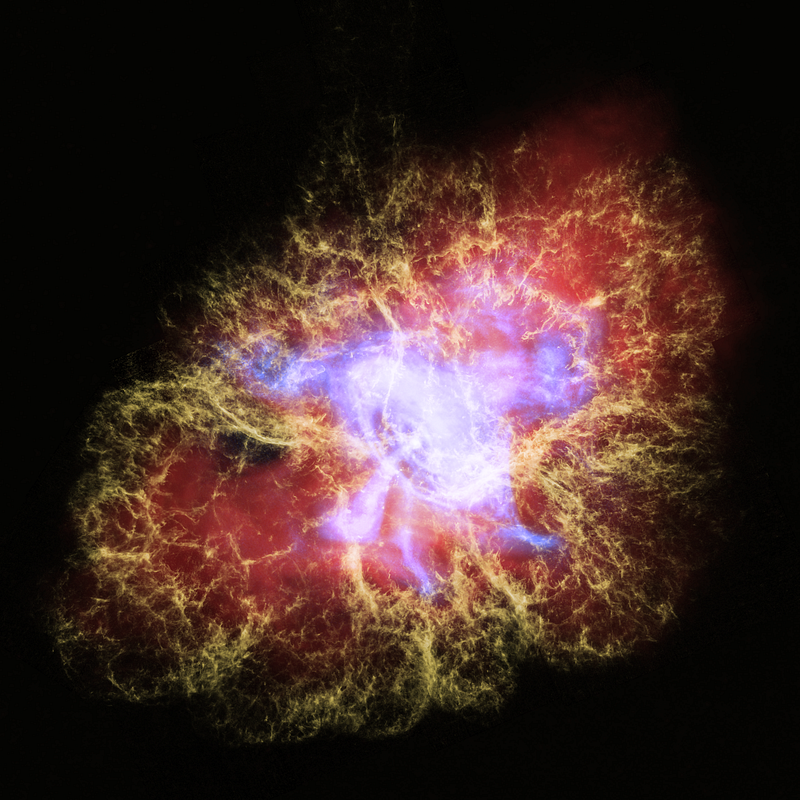
In the year 1054 CE, a sudden light appeared in the sky. It was so bright that it remained visible during the day for more than three weeks, and at night for nearly two years1.
It wasn’t a new star. What ancient observers witnessed was the explosion of a supernova — the death of a star located some 6,500 light-years from Earth.
The collapse of that star became visible in a region of the sky we now know as the constellation Taurus, though its light had actually begun its journey around the year 5446 BCE.
Chinese astronomers at the time described it as a “guest star”2, and their sky-watching was so precise3 that they placed the supernova within one degree of its actual position, documenting both its duration and apparent brightness.
There is also evidence in Japanese records (though less detailed), Arabic sources that may allude to the event4, and possible depictions in the petroglyphs of Native American peoples5.
In Europe, some documents might reference it as well, although their language is more ambiguous and less rigorous from an astronomical standpoint6.
None of these cultures had contact with each other — and yet they all saw the same thing. The sky was their bridge.
That stellar cataclysm left behind a cloud of gas now known as the Crab Nebula7, a ghostly remnant that still glows faintly in the night sky. Its apparent magnitude (8.4) means you’d need at least a small telescope to detect it.
To me, the most extraordinary part of this story is the coincidence among strangers: civilizations separated by time and geography, all looking up at the same sky and being moved by the same light.
Perhaps that says more about us than any ancient record — that even across eras, cultures, and lands, we were able to gaze with awe at the unfathomable mystery of the universe.
This piece was originally published in Spanish. You can read the original version here.
References
¹ ² Supernova 1054 — Creation of the Crab Nebula — SEDS USA ↩ ↩
³ Suspected New Stars Recorded in Old Chronicles and Among Recent Meridian Observations — Zenodo ↩
⁴ ⁶ Was the supernova of AD 1054 reported in European history? — Astrophysics Data System ↩ ↩
⁵ Chaco Canyon in New Mexico, and its astronomical rock art — EarthSky ↩
⁷ Crab Nebula — Space Telescope Science Institute ↩